
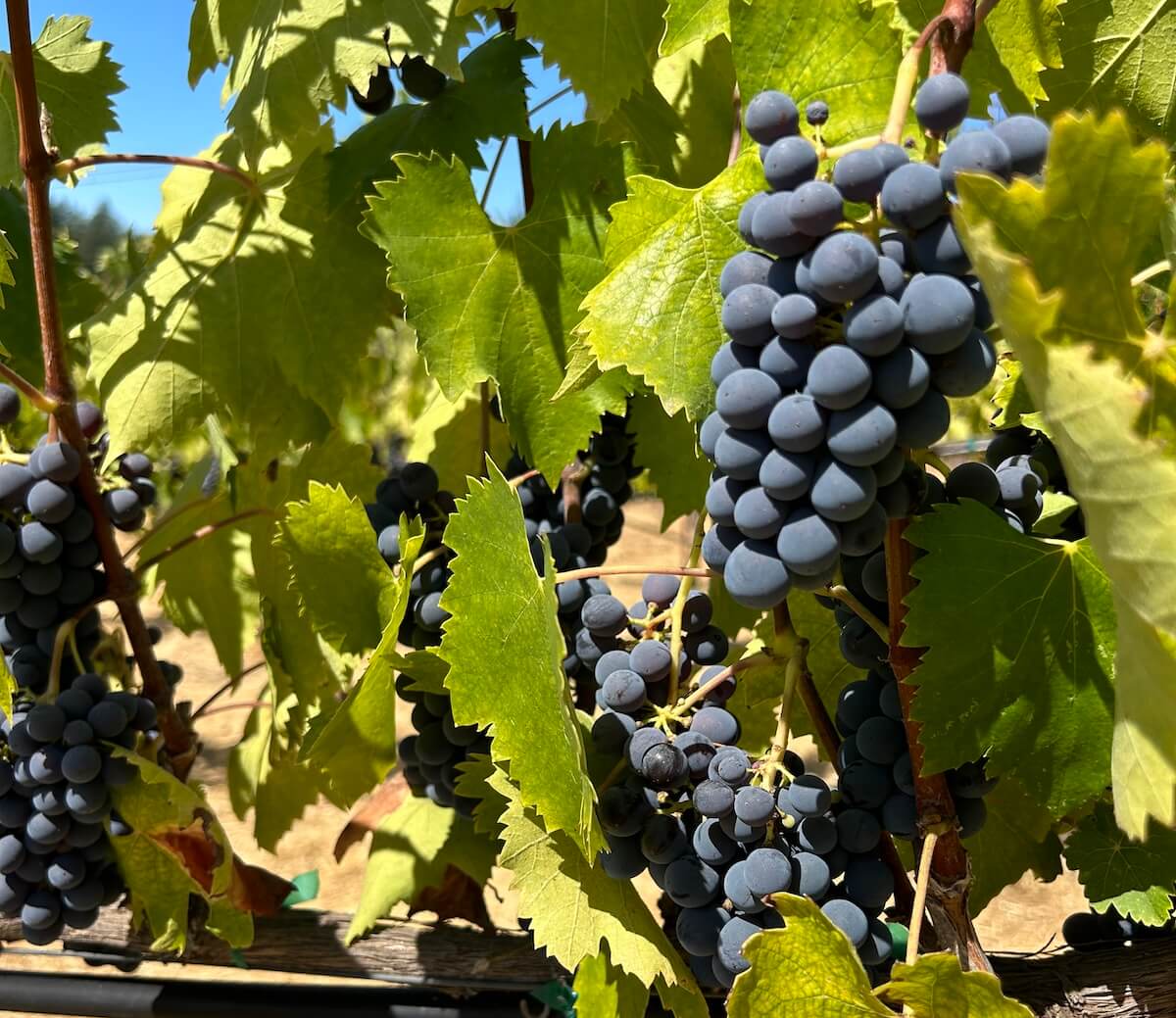
Italian wine has long stood for passion, heritage, and complexity. And while we’re thousands of miles from Italy’s rolling hills, we’ve found that those same Italian grape varieties like Sangiovese, Barbera, and Fiano thrive in California – especially at our farm in Healdsburg, nurtured by our regenerative farming and vineyard-centric focus.
What Makes Italian Wine Grapes Thrive in Northern California?
Humans have spent centuries experimenting with different grape varieties in different locations, all in search of the answer to the question, “What’s the best grape to make great wine here?” There are over 10,000 different grape varieties worldwide, of which noted authority Jancis Robinson identified 1,368 currently used to make wine.
Why so many? One word: climate.
This map, derived from the Köppen-Geiger World Climate Project, helps explain why.
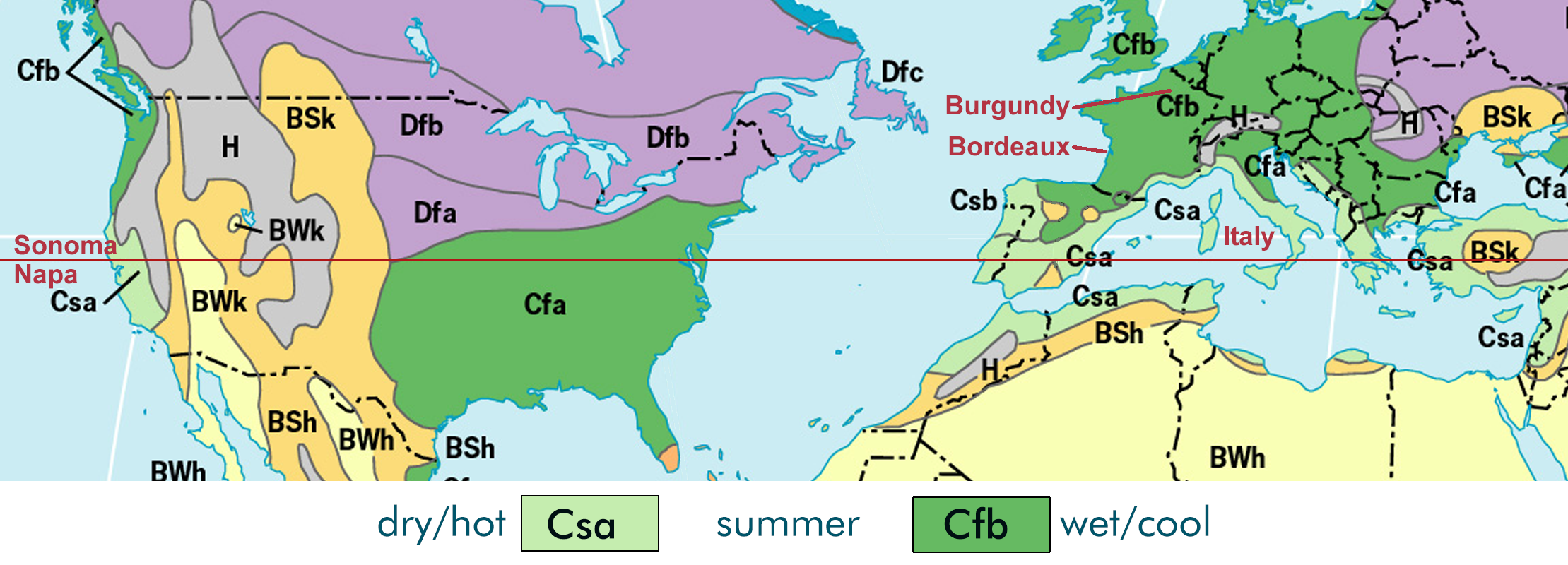
It clearly shows that California shares a climate not with the regions of Bordeaux (home to Cabernet, Merlot, and Sauvignon Blanc) or Burgundy (home to Pinot Noir and Chardonnay), but rather with the Mediterranean – especially the western portion of Italy, southernmost France, and much of Spain.
That understanding – supported by our success with the olive oil we make from trees we imported from Tuscany in 1990 (and our love of all things Italian!) – led to our decision to experiment with Italian grape varieties.
We started with Sagrantino (the grape that first compelled us) and Sangiovese, and were thrilled with the results from the first harvest. Then we purchased the winery property, and added six more: Barbera, Malvasia Bianca, Moscato, Montepulciano, Nebbiolo, and Pinot Nero; all did well. But the ones grown in northern Italy (Nebbiolo and Pinot Nero) were good but not great, so we grafted those vines over to Greco and Fiano (both from Campania), as well as more Montepulciano. And we took out the Moscato to make more room for Malvasia Bianca, which was producing outstanding wine. We added a new block where we grow Pallagrello Bianco (also from Campania), and another on our home farm where we planted more Barbera.
We also tracked down other sources, in both Mendocino county as well as in Lodi, which brought us additional Sangiovese grapes, plus Vermentino, Carignano, and Cannonau (its name in Italy; it’s also known as Garnacha in Spain), and small amounts of several other varieties that allowed us to experiment.
To us, our quest for “What’s the best thing to grow here is central to our story. It’s only when we get the varietals right that our regenerative farming approach, rooted in biodiversity and balance, can be fully expressive in the wine.
The Difference Between an Italian Grape and an Italian Wine
A lot of people use “grape” and “wine” interchangeably, but they’re not quite the same. Especially in Italy. An Italian grape refers to the varietal, like Barbera, Sangiovese, or Vermentino, while Italian wine is the final product made under Italy’s regulations.
For example, Barbera is a grape. In Italy, wines labeled “Barbera d’Alba” or “Barbera d’Asti” follow specific and usually strict DOC or DOCG guidelines set by the regional consortium of “Alba” or “Asti” where the grapes and wines are grown and made.
Here in Sonoma, we work with that same grape but vinify it in a way that reflects our land, climate, and creative philosophy.
Italian Grapes Become California Wine
We’ve built our program around the idea that Italian wines can be both true to their origins and uniquely expressive of our land. We grow both red and white varietals that capture the best of both worlds.
Italian Red Wines and Their Flavor Profiles
Our red wines are varietally expressive, food-friendly, and full of character:
Barbera
With bright acidity, cherry and plum notes, and soft tannins, our Barbera delivers a lively, elegant profile that nods to its Piedmont roots. → Try it with grilled sausage, roasted mushrooms, or anything tomato based.
Sangiovese
A Tuscan classic, Sangiovese thrives here. Ours offers notes of red currant, dried herbs, and a hint of spice. → Perfect with wood-fired pizza, roasts, and wild mushroom risotto.
Montepulciano
Deeper and darker, our Montepulciano is layered with black fruit, cocoa, and savory undertones. Among red wine grapes grown in California, this variety stands out for its intensity and food-pairing versatility. → It pairs beautifully with short ribs or aged cheeses.
Sagrantino
This is a powerhouse red, and one of the rarest varietals (fewer than 2,000 acres are planted in its native Umbria). Our Sagrantino maintains its deep tannins but softens into something complex and age-worthy. → Best enjoyed with rosemary-infused lamb, a juicy steak, or pasta with a rich meat ragu.
Italian White Wines and Their Flavor Profiles
Our whites are refreshing, aromatic, and packed with personality:
Malvasia Bianca
A rare gem we farm in small amounts and one of the more obscure wine varietals in our collection. Our dry Malvasia Bianca shows off floral notes of orange blossom and jasmine, with notes of pear and lychee, beautifully balanced by acidity, minerality and citrus zest. This unique vine variety represents our dedication to preserving and celebrating lesser-known Italian treasures. → Pair it with grilled peach and burrata salad or fresh garden dishes.
Fiano
Considered one of Italy’s most noble white grapes, its floral and fruity bouquet highlights notes of citrus, honey and almonds, complemented by pear and melon. It’s slightly creamy texture with balanced acidity is a love letter to southern Italy’s great white wines. → Delicious with caprese, roast chicken, or creamy cheeses.
Vermentino
Crisp and coastal. Our Vermentino brims with citrus zest, sea spray minerality, and white peach. → Ideal with oysters, grilled fish, or lemon chicken.